M.A. -Thesis
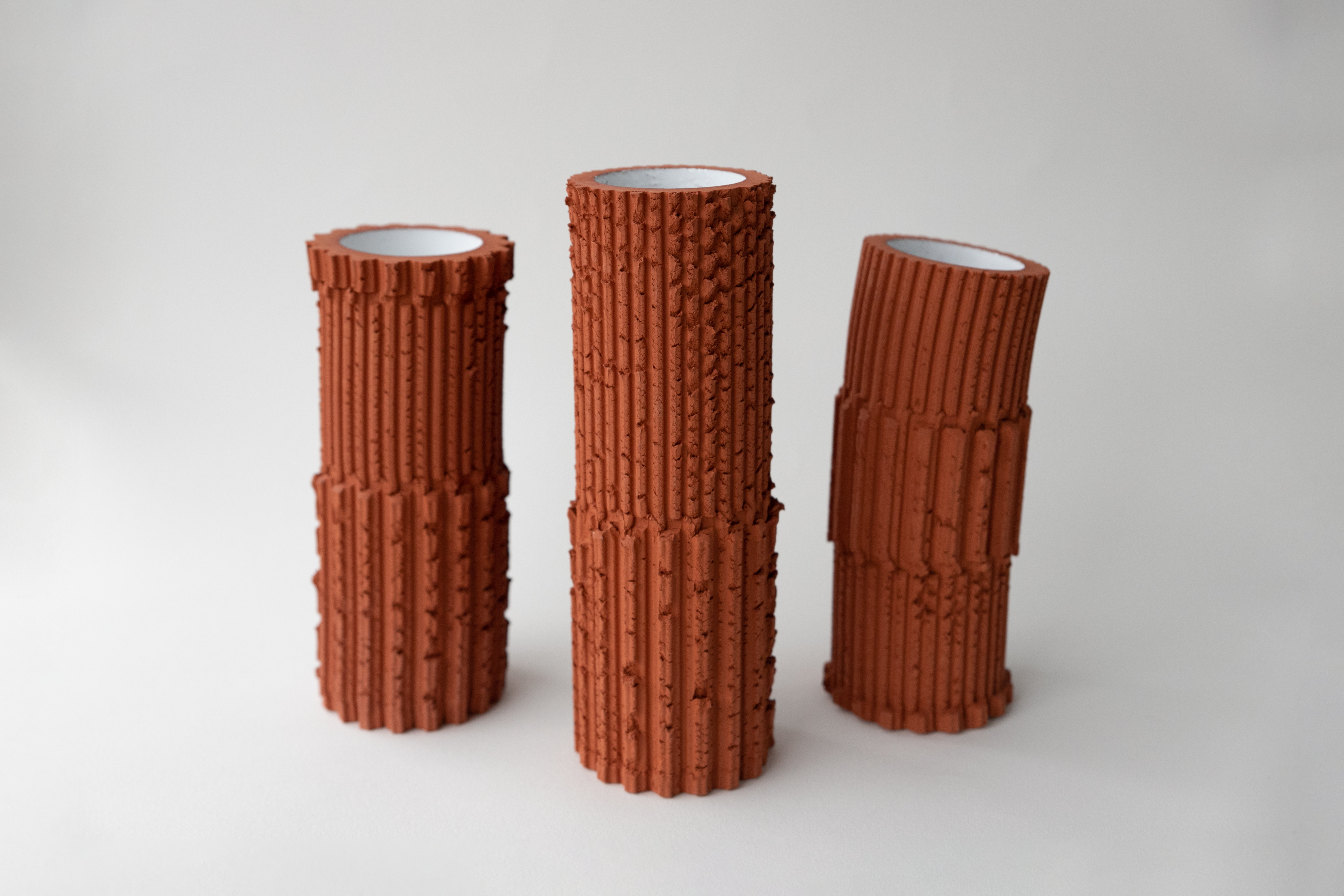
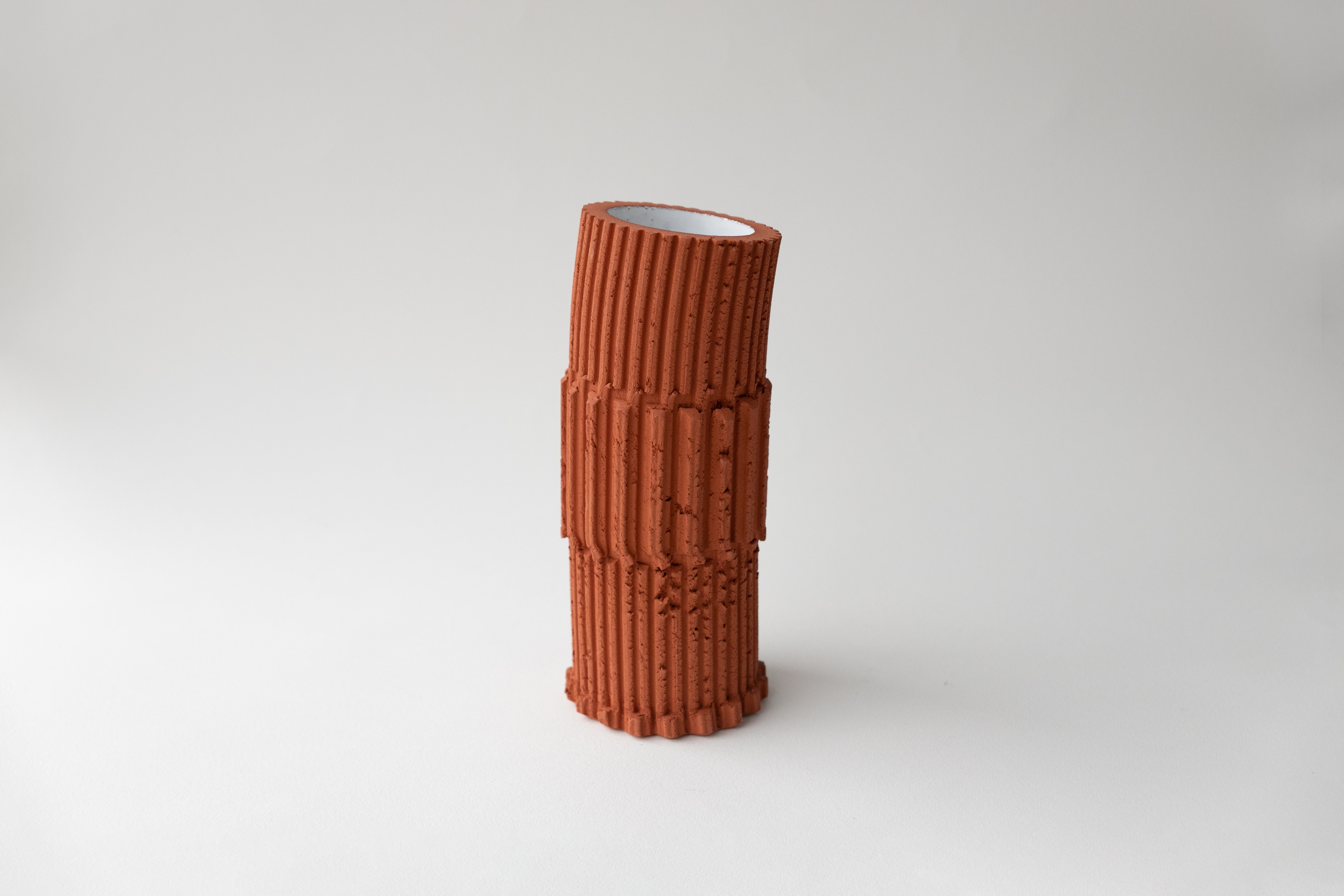
What if impermanence is a quality, not a flaw? Wet Weaving interweaves ceramics and textiles into porous structures: yarn is dipped in clay, woven, dried, and fired. Cracks and pores enable passive cooling and temporary storage—activated by sunlight as a collaborator. From 14 samples, the Porous Panel System emerged through an interplay of experimentation and design—a material that functions not in spite of, but because of its imperfections, developed in the spirit of decentralized design.
Supervision: Prof. Dr. Zane Berzina, Prof. Dr. Lucy Norris
Weißensee Kunsthochschule
︎ Material: Clay, natural fibers.
︎ Dimensions: 180x45x60 cm
︎ Availability: Prototyping
Ben Wesch
Berlin, DE
The present is shaped by overlapping crises: climate change, growing inequality, and the centralization of knowledge and production. These developments are rooted in a worldview that strictly separates humans from nature, design from fabrication. Wet Weaving is a response: an experimental material methodology that combines technical innovation with a different design sensibility.
Wet Weaving draws on three design principles. Design Global, Manufacture Local understands knowledge as a commons, translated into production locally. Commons-Based Peer Production describes the collaborative creation of knowledge and physical commons beyond market logic. More-Than-Human Design expands the design process to include non-human beings, materials and environment as active co-creators.
Yarn is dipped in liquid clay, woven onto a frame, dried, dipped again, and fired at 900°C. The yarn burns away completely – what remains is a ceramic structure whose porosity corresponds to the textile weave. The clay is fully circular: rejects become grog – raw material for new ceramic bodies. Cracks that form during the process are not defects but functional properties – they increase the evaporation surface and enable passive cooling and temporary water storage.
Across a series of 14 samples, variables such as yarn type, weave pattern, clay consistency, and drying processes were iteratively tested. Sample 9 achieved up to 15°C of temperature reduction – demonstrating controlled crack formation as quality, not flaw.
Through the interplay of experimentation and design, the Porous Panel System emerged – a translation of the material principle into architectural scale. It contributes to the Sponge City: absorbing rainfall, storing water, and counteracting urban overheating. The system is openly documented and reproducible with simple means – not a singular product, but a link in a living network.
What if impermanence is a quality, not a flaw? Wet Weaving interweaves ceramics and textiles into porous structures: yarn is dipped in clay, woven, dried, and fired. Cracks and pores enable passive cooling and temporary storage—activated by sunlight as a collaborator. From 14 samples, the Porous Panel System emerged through an interplay of experimentation and design—a material that functions not in spite of, but because of its imperfections, developed in the spirit of decentralized design.
Supervision: Prof. Dr. Zane Berzina, Prof. Dr. Lucy Norris
Weißensee Kunsthochschule
︎ Material: Clay, natural fibers.
︎ Dimensions: 180x45x60 cm
︎ Availability: Prototyping
Ben Wesch
Berlin, DE
The present is shaped by overlapping crises: climate change, growing inequality, and the centralization of knowledge and production. These developments are rooted in a worldview that strictly separates humans from nature, design from fabrication. Wet Weaving is a response: an experimental material methodology that combines technical innovation with a different design sensibility.
Wet Weaving draws on three design principles. Design Global, Manufacture Local understands knowledge as a commons, translated into production locally. Commons-Based Peer Production describes the collaborative creation of knowledge and physical commons beyond market logic. More-Than-Human Design expands the design process to include non-human beings, materials and environment as active co-creators.
Yarn is dipped in liquid clay, woven onto a frame, dried, dipped again, and fired at 900°C. The yarn burns away completely – what remains is a ceramic structure whose porosity corresponds to the textile weave. The clay is fully circular: rejects become grog – raw material for new ceramic bodies. Cracks that form during the process are not defects but functional properties – they increase the evaporation surface and enable passive cooling and temporary water storage.
Across a series of 14 samples, variables such as yarn type, weave pattern, clay consistency, and drying processes were iteratively tested. Sample 9 achieved up to 15°C of temperature reduction – demonstrating controlled crack formation as quality, not flaw.
Through the interplay of experimentation and design, the Porous Panel System emerged – a translation of the material principle into architectural scale. It contributes to the Sponge City: absorbing rainfall, storing water, and counteracting urban overheating. The system is openly documented and reproducible with simple means – not a singular product, but a link in a living network.


Modular furniture system.
This sideboard marks the start of our collaboration with the stonemasonry Roessler&Schwarz aiming at the revalorization of their stone offcuts and otherwise unusable slab leftovers.
︎ Material: Travertine limestone, stained pine wood, steel hardware
︎ Dimensions: 180x45x60 cm
︎ Availability: For sale
Konrad Freyer
Kiel, DE
This sideboard marks the start of our collaboration with the stonemasonry Roessler&Schwarz aiming at the revalorization of their stone offcuts and otherwise unusable slab leftovers.
︎ Material: Travertine limestone, stained pine wood, steel hardware
︎ Dimensions: 180x45x60 cm
︎ Availability: For sale
Konrad Freyer
Kiel, DE